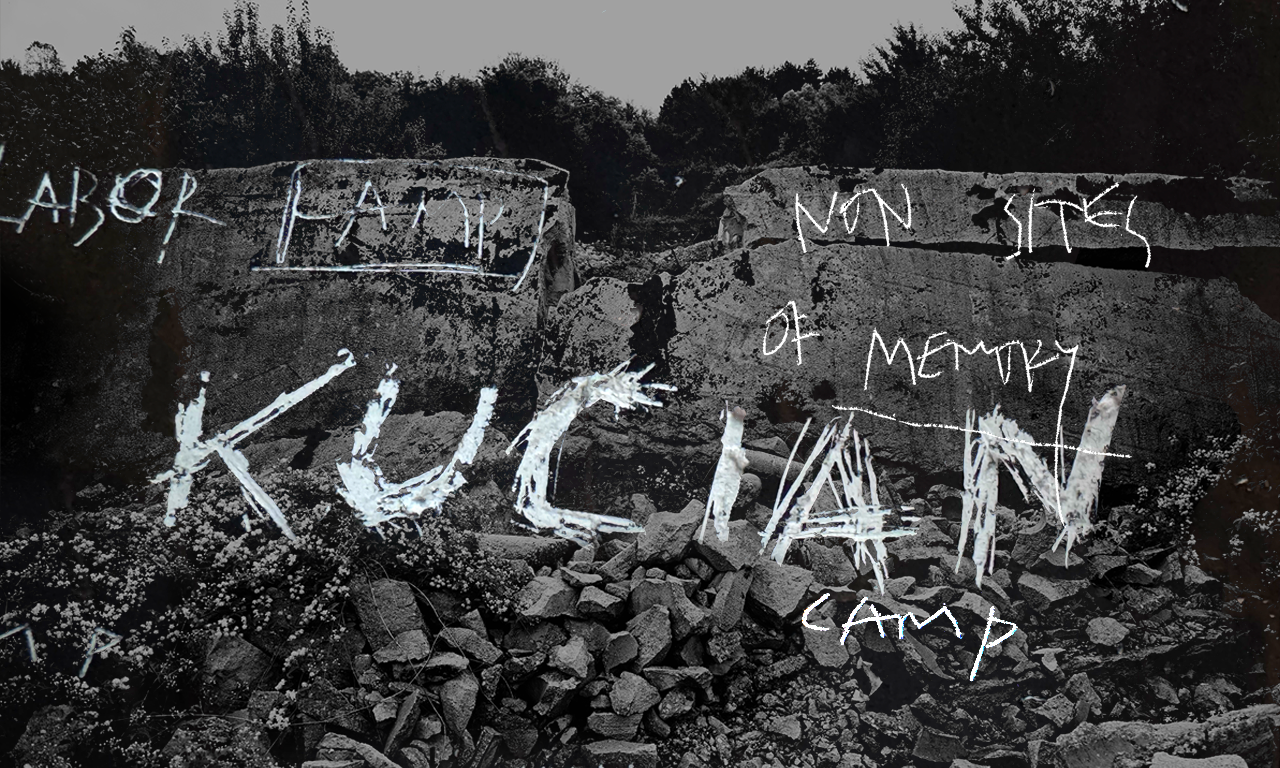
HOW DO WE REMEMBER ?
WHO WRITES OUR HISTORY?
CAN NATURE PRESERVE TRACES OF VIOLENCE?
HOW IS A SOCIETY’S COLLECTIVE MEMORY FORMED?
They are places whose histories may remain unmarked, partially erased, difficult to recognise, or absent from the material culture of commemoration. They may bear no monument, sign, or other visible marker. Some are absorbed into the ordinary landscape; others remain present through ruins, altered terrain, vegetation, or fragments of infrastructure.
They are not necessarily forgotten. Rather, memory and forgetting coexist within them, while the traces of what happened may remain embedded in the site itself.
Between 1944 and 1989, there were at least 86 concentration camps and sites of political imprisonment in Bulgaria. During the totalitarian regime of the Bulgarian Communist Party, nearly 250,000 people passed through the country’s system of political repression.
The development of this system coincided with the nationalisation of property and a fundamental restructuring of labour and ownership. Political repression therefore became closely entangled with existing industrial landscapes – mines, transport networks, industrial facilities, and workers’ settlements.
After the fall of the regime in 1989, the legacy of this period has been addressed through archival research, public commemorations, memorial initiatives, and civic and artistic projects. Yet much of this history remains only partially present in public memory, particularly among younger generations.
The sites themselves have followed different trajectories. Some have been marked and commemorated; others have disappeared, been transformed, built over, reclaimed by vegetation, or incorporated into the everyday life of the surrounding communities.
It is these spaces of uncertain historical visibility that are at the centre of this project.
The project investigates what has become of them: what remains, what has disappeared, how the terrain has changed, and how traces of the past continue to exist within the contemporary landscape. It also asks how these places persist – or fail to persist – within collective memory.
Through contemporary photography, archival images, maps, documents, and fieldwork, we examine the material reality of these sites: surviving buildings and infrastructure, mines and former labour sites, changes in the terrain, spoil heaps, vegetation, new construction, and other elements through which the past is concealed, transformed, displaced, or made visible.
The project also looks at the ways these territories are inhabited and used today, including the presence of marginalised communities in some of them.
Kucian was one of the early sites connected to the system of political camps established in Bulgaria after 9 September 1944. Located within the mining region of Pernik, it formed part of an already existing industrial landscape shaped by coal extraction.
The camp, the Kucian open-pit mine, the Tolbukhin / Bogdanov Dol underground mine, transport routes, and workers’ settlements occupied the same spatial environment. Political repression, labour, and industrial production were therefore not separate spatial realities, but intersected within the same terrain.
Today, this landscape has been substantially transformed. Parts of its former infrastructure have disappeared. Other elements survive in altered form or have been absorbed into the contemporary environment. The territory itself continues to be inhabited, crossed, used, and changed.
Kucian can therefore be read as an industrial palimpsest – a site in which different historical processes have left traces upon the same terrain: political repression, mining, labour, destruction, construction, abandonment, and contemporary inhabitation.
These layers, however, are neither stable nor clearly separated. Material traces disappear, vegetation covers structures, the terrain is reshaped, buildings are demolished or constructed, and former industrial spaces acquire new uses. What remains is not a fixed historical landscape, but a site in continuous transformation.
The research combines archival and biographical research, topographic analysis, mapping, fieldwork, sensory ethnography, and visual methods.
Fieldwork and local knowledge are brought into dialogue with the archival record. They allow us to examine what can still be encountered on the ground: material remains, changes in the terrain, patterns of movement and use, and places where visible evidence has disappeared.
Photography and other visual methods are used not simply to illustrate the historical record, but to examine the relationship between past and present within the site itself – between what is visible and what is no longer visible, between material persistence and disappearance, and between memory and forgetting.
The project thus approaches Kucian as a collection of traces: a changing landscape in which historical processes remain materially present, even when they are no longer immediately legible.
It asks what happens to memory when the physical traces of the past are gradually transformed, absorbed into everyday life, or disappear altogether.